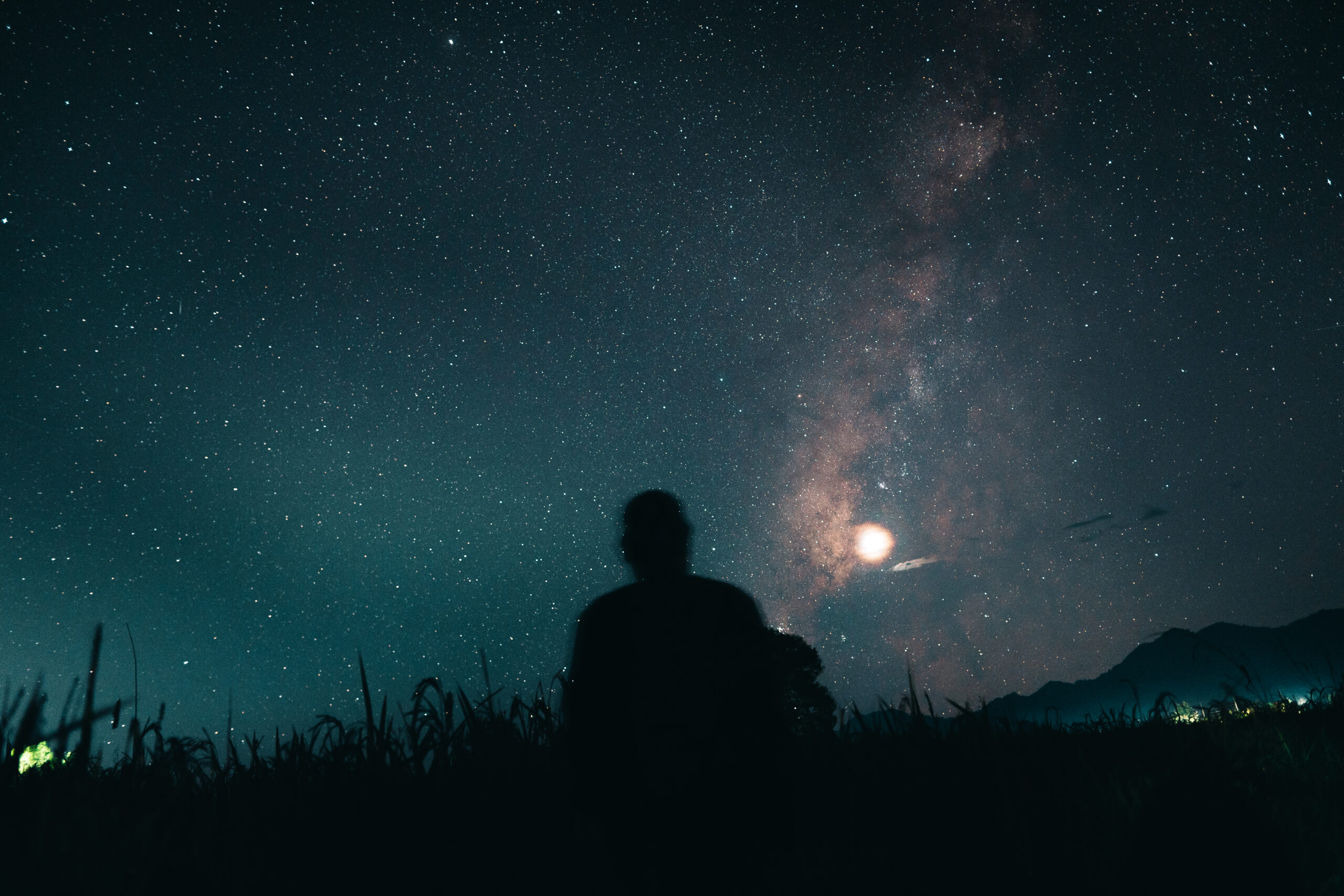

A finite life gains meaning through love, truth, and responsibility.
Key points
- Awareness of mortality can deepen authenticity and clarify what matters most.
- Our lives are brief, but they profoundly shape the worlds of those we love.
- Fragility gives human choices urgency, weight, and meaning.
- A meaningful life is built through love, truth, courage, and responsibility.
A few years ago, I watched the film Contact with Jodie Foster. At the end of the film, there is a shot of her standing in her backyard looking up into the sky. As the camera pans away from her face, smiling slightly, the angle of view becomes wider until she is no longer visible. Next, the yard is shown along with her home and state, and eventually the Earth’s atmosphere. The moon passes in front of the Earth and continues its journey past other galaxies and others. I felt nauseous during this sequence,
and I was overcome with a sense of insignificance. Today, I read a social media post where someone had asked a very similar question; “What does it mean to live a finite, fragile life in an infinite, eternal universe?”
Still trying to wrap my mind around this question, but to me it seems that, even though human life is incredibly small, it is also completely important.
When viewed from the Universe’s side (the Cosmic Perspective), we are merely a brief occurrence (a flash of consciousness) and a momentary pattern of matter and memory. The stars have been around for millions or billions of years and will remain long after we are gone. Therefore, life is seemingly meaningless from that viewpoint.
However, as I look at this from the Human Perspective, although the events and experiences of joy, grief, love, choice, and suffering are fleeting, their reality is not. To my son, my wife, my parents, my friends, my clients, and the men I hope to assist, we are not inconsequential. Even though we may not be at the center of the universe, we are at the center of our worlds.
The reason our fragility lends itself to meaning is that if our lives were never-ending, urgency would cease to exist. The fact that time is short, relationships can be severed, bodies deteriorate, and opportunities pass us by is exactly what adds importance and weight to our decision-making. A flower is beautiful because it blooms quickly. A sunset is meaningful because it fades. A person is meaningful because he/she dies.
Existentialists have helped to add to our understanding of existential meaning. For example, Martin Heidegger stated that the knowledge of one’s own mortality enables one to be authentic. Viktor Frankl said that meaning emerges when we take responsibility for meeting life’s expectations. Soren Kierkegaard described human existence as a contradiction between the finite nature of humans and the infinite nature of eternity. All three authors indicate that death is not an enemy of meaning, instead death is an essential aspect of having meaning.
On a psychological level, accepting that we are finite beings means we can’t control everything. We will lose people. We won’t be able to keep them all. We won’t grow into everything we want to be. We will die. However, before that day arrives, we can do amazing things such as: love passionately, tell the truth as much as possible, create and produce, seek forgiveness, protect others, serve others, and become more complete versions of ourselves.
Many spiritual beliefs share a common idea that humanity is composed of finite physical forms that participate in something greater than themselves (an eternal component). We are mere vessels carrying various aspects including but not limited to: consciousness, love/moral accountability, and for me, a spirit/soul. Our bodies are temporary. The questions we wonder about are eternal.
Imagine lighting a candle in your backyard on a clear night. The sky above you is vast and endless. The flame from the candle is relatively small compared to the endlessness of the sky. Still, the purpose of the candle isn’t to shine brighter than the sky. It exists simply to burn brightly while it remains lit.
To answer my original question that I posed to you in reading this article. How do I live a finite/fragile life in an infinite/eternal universe? Simply put — just kidding — It means that since I’m not going to be here forever and because of that each act of love/courage/sacrifice/truth matters. It really matters. I do not want to end up like Tolstoy’s Ivan Ilyich, who on his deathbed, had a different question: “Maybe I did not live as I ought to have done.”
We have, I have, been given a great honor, a temporary responsibility to live a life where we should take advantage of every opportunity to love and hopefully be loved.