
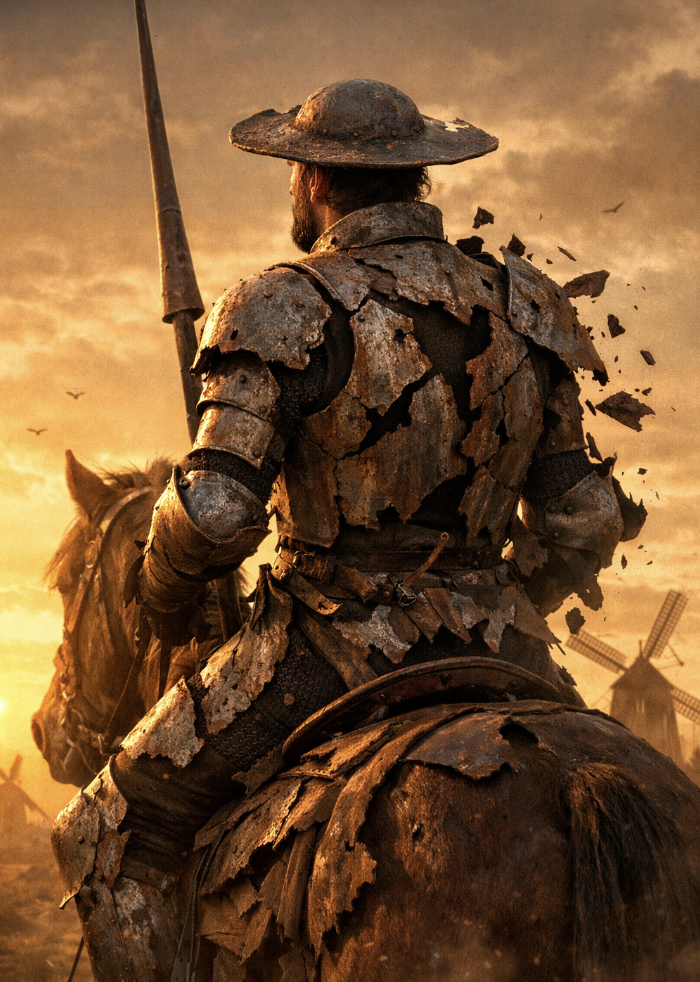
There’s a scene in The Man of La Mancha where Don Quixote, wearing rusted armor and stubborn hope, charges at a windmill he believes is a giant. Everyone laughs. They call him a fool. Maybe even insane. Asleep at the wheel. But maybe he’s the only one actually awake.
Because behind the armor, Don Quixote is just a man who doesn’t want to live in a world that no longer believes in beauty, courage, or love. So, he creates one. A better one. Even if it costs him everything. Yes, it’s easy to write him off as a madman. But for a lot of American men today, Don Quixote feels like a mirror.
The Emotional Blueprint of American Men
In the U.S., boys are taught early how to survive, not by understanding themselves, but by shutting parts of themselves down. Emotional pain is something to walk off. Sadness is hidden behind a joke or a clenched jaw. Vulnerability is something you run from or apologize for.
This training isn’t always intentional, but we see it everywhere, in locker rooms, in media, in families. By the time a man reaches adulthood, he’s often fluent in toughness, silence, and performance, but emotionally illiterate.
The result? Entire lives built around control, productivity, and invisibility. Built behind a mask. And for a while, it works. Until it doesn’t.
When the System Starts to Crack
At some point, often quietly, something shifts. It might come in the form of burnout, relationship struggles, addiction, depression, or just a gnawing sense that something’s missing. The usual metrics for success, job titles, income, fitness, and being “the rock” suddenly feel hollow.
Even men who seem to be doing everything “right” find themselves wondering why they feel so far from themselves. Why does joy feel distant? Why does nothing taste like anything anymore?
This isn’t a weakness. It’s a signal. A crack in the mask. And in that space, something deeper often begins to stir.
Don Quixote and the Rebellion of Feeling
When the world around him became too hollow, Don Quixote chose something bold. He didn’t give up; he imagined something more. He moved from ambition to meaning. He picked up a shaving bowl and called it a battle helmet. Called himself a knight. And set out to reclaim meaning in a world that had lost it.
He saw beauty where others saw brokenness. He honored dignity where others saw shame. He named the sacred where others saw the ordinary. To the world, that made him delusional. But maybe it made him sane.
Because sometimes the world becomes so disconnected, so cynical, that the only sane response looks like madness, especially when that madness is fueled by conviction.
The Noise Men Carry
For many American men, life isn’t just loud, it’s filled with the kind of inner noise that numbs the soul. There’s the pressure to perform, to be invulnerable, to stay busy, to never need help. There’s the shame that rises the moment emotion tries to surface. There’s that inherited voice from childhood whispering the old code: “Stop your crying. Walk it off. Tough it out. Don’t talk about it.”
Over time, that script doesn’t just quiet pain, it silences joy. It may flatten connections. It can sterilize intimacy. So men perform. They produce. They endure. But the cost is often a growing disconnection from themselves, their families, and their own sense of purpose.
The Call to Feel Again
And yet, beneath all that conditioning, something inside many men is desperate to come alive again. Not to be fixed, but to feel. Some find it through therapy. Some through crisis. Some through recovery. Others find it in quiet moments: holding a child, listening to music, standing alone at dawn.
There’s a hunger not just for peace, but for permission, permission to let the armor crack a little. To let the feelings come back. This isn’t about abandoning masculinity. It’s about expanding it. Strength isn’t just grit and resilience. It’s also honesty, presence, softness, and the courage to show up whole.
Don Quixote didn’t run from reality, he created a new one, rooted in meaning, imagination, and love. And in doing so, he became a symbol for every man who wants something deeper than just survival.
To the American Man
You don’t have to bumrush windmills. But maybe you do need to let something in you ride again. You don’t have to keep numbing just to function. You can stop pretending you’re not worried, scared, unsure, or tired.
You can want something different, something real, and that doesn’t make you weak. It makes you human. If you’re feeling like something inside you is waking up — a restlessness, a sadness, a desire to break out of the script — you’re not alone. You’re not crazy.
You’re just ready. And maybe, just maybe… it’s time to ride again.